
The best JavaScript data grids in 2026
We strive to keep posts updated, but code samples may sometimes be outdated. Humans, see the Bryntum documentation; agents, https://mcp.bryntum.com for the latest info.
Finding the right JavaScript data grid for your web app is one of those choices that compounds over time. The wrong pick means workarounds for missing features, performance issues with large datasets, or unexpected licensing costs. We’ve compared five popular libraries across features, ease of use, and pricing to help you choose. All five support React, Angular, and Vue:
We’ll compare their features, pricing, pros, and cons to help you choose the best grid for your use case. Whether you’re using React or want a free open-source option, we’ve got you covered.
AG Grid
AG Grid is one of the most widely used JavaScript data grid libraries, offering both a free Community version and a commercial Enterprise version. It’s built with TypeScript and supports React, Angular, and Vue. The AG Grid Demos showcase advanced examples and the AG Grid Docs feature live code demos that you can edit in CodeSandbox or Plunker.
Getting started
There are several ways you can add AG Grid to your project:
- Download the package and use the source files.
- Use a CDN.
- Use npm to install the Community version:
npm install ag-grid-community - Or the Enterprise version:
npm install ag-grid-enterprise
You can test AG Grid Enterprise locally without a license. To use it in production, access support, and remove the watermark and console warnings, request a trial license. Follow the quickstart guide for your frontend framework to get started.
To create a basic AG Grid, you need a container element and a grid configuration:
import {
  AllCommunityModule,
  GridApi,
  ModuleRegistry,
  createGrid,
} from "ag-grid-community";

ModuleRegistry.registerModule([AllCommunityModule]);

let gridApi;

const gridOptions = {
  // Data to be displayed
  rowData: [
    { make: "Tesla", model: "Model Y", price: 64950, electric: true },
    { make: "Ford", model: "F-Series", price: 33850, electric: false },
  ],
  // Columns to be displayed (Should match rowData properties)
  columnDefs: [
    { field: "make" },
    { field: "model" },
    { field: "price" },
    { field: "electric" },
  ],
  defaultColDef: {
    flex: 1,
  },
};

gridApi = createGrid(
  document.querySelector("#myGrid"),
  gridOptions,
);
AG Grid uses Row Models to load data into the grid. There are four Row Model types:
- Client-Side
- Server-Side
- Infinite
- Viewport
The Client-Side Row Model loads all of the data into the grid at once.
When using the Client-Side Row Model for loading data, you can use client-side single row updates to update data in specific rows or transactions.
Rather than loading all the data in one go, the Server-Side Row Model lazy-loads data from the server, making it ideal for working with large datasets.
To configure the grid to use the Server-Side Row Model, set the rowModelType property in the gridOptions object to “serverSide”:
const gridOptions = {
  rowModelType: "serverSide",
  // other grid options
};
To fetch data from the Server-Side Row Model, you need to define a Datasource. The Datasource contains a getRows() method that accepts request params from the grid and returns data from a fetch request to the grid:
const datasource = {
    getRows(params) {
        console.log(JSON.stringify(params.request, null, 1));

        fetch('./olympicWinners/', {
            method: 'post',
            body: JSON.stringify(params.request),
            headers: { 'Content-Type': 'application/json; charset=utf-8' }
        })
        .then(httpResponse => httpResponse.json())
        .then(response => {
            params.successCallback(response.rows, response.lastRow);
        })
        .catch(error => {
            console.error(error);
            params.failCallback();
        })
    }
};

// register datasource with the grid
gridOptions.api.setServerSideDatasource(datasource);
AG Grid comes with several built-in themes. To apply a theme, first import it from the ag-grid-community package:
import { themeQuartz } from 'ag-grid-community';Then, set your chosen theme in the gridOptions object:
const gridOptions = {
    theme: themeQuartz,
    ...
}
For example, an AG Grid styled with the Quartz theme looks like this:
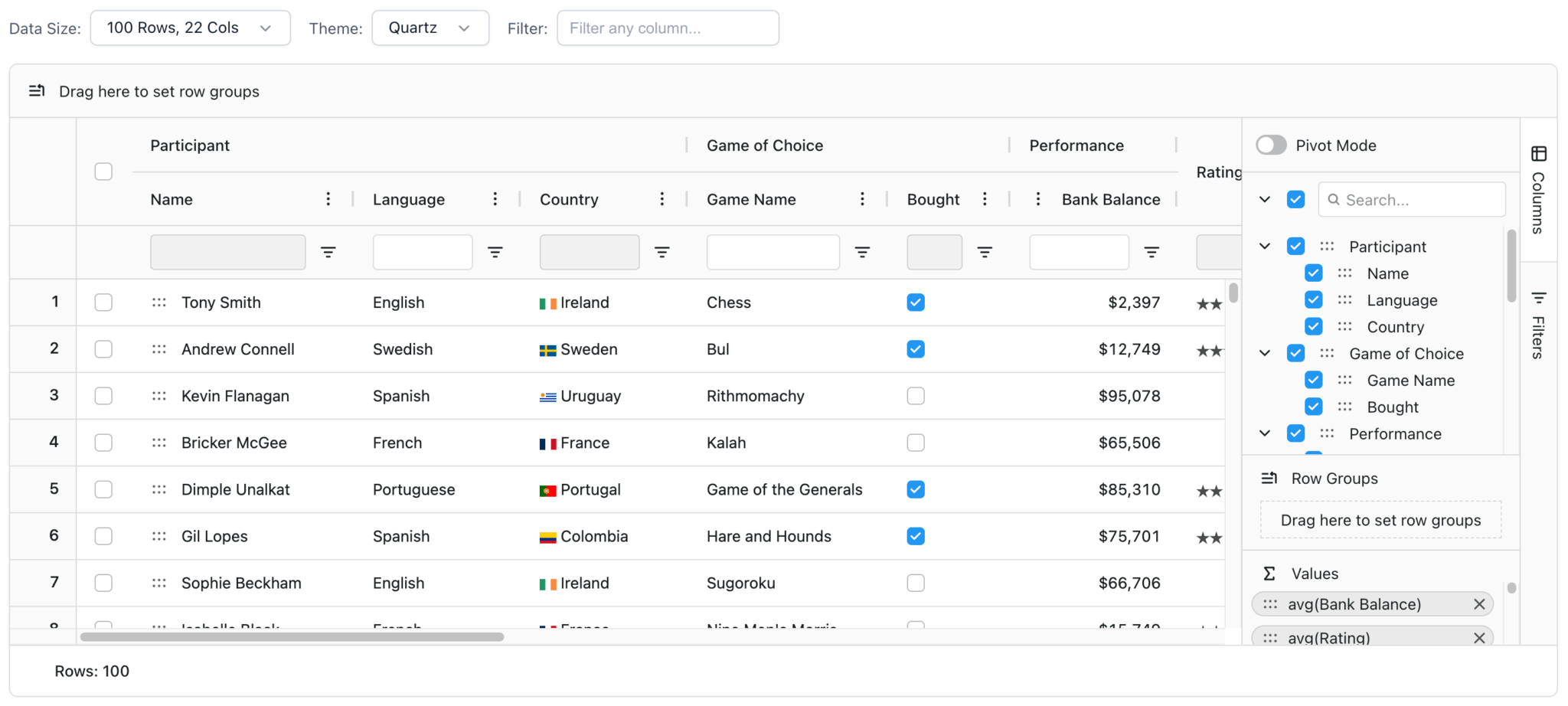
The Quartz and Material theme use specific fonts, if available. You can load these fonts yourself or pass the loadThemeGoogleFonts grid option to load them from Google’s CDN. You can see the customizing fonts docs for more information.
Features
AG Grid’s free and open-source community edition includes all the core features you’d expect from a professional data grid:
- Sorting, filtering, and pagination
- Custom cell rendering
- Spreadsheet-like features, including formulas (via the
allowFormulacolumn option andFormulaModule) and cell validation (built-in constraints on provided editors, customgetValidationErrorscallbacks, and cross-field full-row validation) - Themes and styling
- Accessibility support
- Performance optimizations using column and row virtualization
- PDF and Excel exports (Enterprise version only)
AG Grid Enterprise adds advanced functionality, including:
The performance demo illustrates how the AG Grid handles large datasets with performance-optimizing features such as:
- A Server-Side Row Model for lazy loading large datasets
- Minimal DOM interactions
- DOM virtualization
- Value caching
- Row virtualization
AG Grid also provides AI integration through two features:
- An AI Toolkit (Enterprise) that lets you integrate AG Grid with your own LLM, so end users can query and manipulate grid state using natural language.
- An MCP Server (available in the Community edition) that exposes prompts (for creating a new grid or migrating to a new version), resources (docs, API reference, and example search), and tools (search docs, detect and set AG Grid version).
Pricing
AG Grid Community is completely free, including for production use. No license is required.
You require a license to use AG Grid Enterprise in production. The AG Grid Enterprise license starts at $999 per developer per year.
Pros
AG Grid is a strong choice for projects of any size, with a free Community edition that covers core functionality and an Enterprise edition for advanced use cases. Its benefits include:
- A free, open-source Community edition with no license required for production use
- Documentation with live code demos and good search functionality
- AI integration via an AI Toolkit (Enterprise) for natural-language grid control, plus an MCP Server available in the Community edition
- An active blog where you can keep up to date with the latest features and learn how to use them such as AI Toolkit: Control AG Grid with natural language commands
- A demos page with advanced examples and links to the source code
- A large and active community, with support through GitHub issues (Enterprise users can access Zendesk support)
Cons
Some advanced features require an Enterprise license.
Syncfusion Data Grid
Syncfusion Data Grid is part of Syncfusion’s commercial component library for web, desktop, and mobile apps. Their web JavaScript grid component is built with TypeScript. It supports React, Angular, Vue, JavaScript, Next.js, Blazor, and ASP.NET Core. The Syncfusion Data Grid demos page provides examples that showcase basic and advanced features, as well as the source code and links to editable example code on StackBlitz.
Getting started
You can add Syncfusion Data Grid to your project in various ways:
- Use npm.
- Use a CDN.
- Download it from the Essential Studio® JavaScript build.
To create a Syncfusion Data Grid, add an instance of the grid and pass in the configuration object, which determines the appearance of the grid and where it gets its data from:
import { Grid, Page, Sort, Filter, Group } from '@syncfusion/ej2-grids';

// Register the required modules
Grid.Inject(Page, Sort, Filter, Group);

// Grid configuration
const grid = new Grid({
    dataSource: [
        { name: 'Dan Stevenson', city: 'Los Angeles', id: 1 },
        { name: 'Talisha Babin', city: 'Paris', id: 2 }
    ],
    columns: [
        { field: 'name', headerText: 'Name', width: 200 },
        { field: 'city', headerText: 'City', width: 150 }
    ],
});

// Render the grid
grid.appendTo('#Grid');
Syncfusion Data Grid uses a modular architecture that allows you to inject only the features you need, with module injection. For basic data fetching, you can use the browser Fetch API and pass the data to the dataSource property.
Use the DataManager to simplify getting data from, and syncing data to, a backend:
const dataSource = new DataManager({
  url: 'http://localhost:3001/api/eventsData',
  adaptor: new UrlAdaptor(),
});
There are 13 themes available for styling the grid, which you can further customize using the Theme Studio for Essential JS 2 GUI.
To start styling the grid, import one of the theme CSS stylesheets:
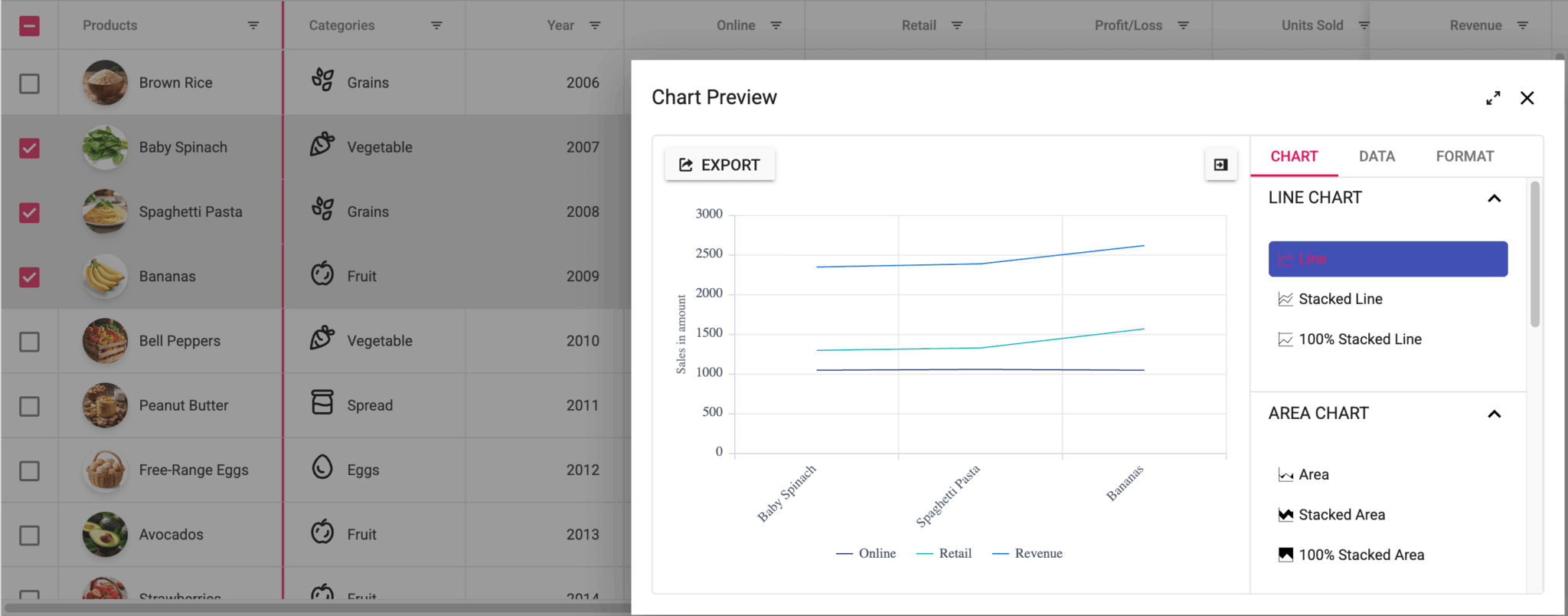
@import "@syncfusion/ej2/material.css";The following example shows a Syncfusion Data Grid styled with the Material theme:
Features
Syncfusion Data Grid’s features include:
- Excel-like filtering
- Grouping
- State management
- Live updates
- PDF and Excel exports with formatting preservation
- Chart integration
Syncfusion also provides AI features in the Data Grid powered by machine learning:
- Semantic filtering adds natural language processing (NLP) so users can search using natural language instead of exact terms.
- Anomaly detection uses machine learning to flag outliers and improve data quality.
The wider Syncfusion suite also includes AI components you can pair with the grid, such as AI AssistView, Chat UI, and Inline AI Assist.
The Theme Studio GUI provides a visual interface for customizing styles without writing code.
Syncfusion provides multiple additional widgets, such as buttons, toasts, and progress bars, for customizing the grid.
The Data Grid performance demo illustrates how it handles large datasets with performance-optimizing features, including:
Pricing
Syncfusion offers a free Community License for qualifying organizations that have:
- Less than $1 million in annual revenue
- Five or fewer developers
- Ten or fewer total employees
You can still qualify for the Community License if you receive external funding from private equity or venture capital, as long as you receive less than $3M.
If you are interested in a commercial Syncfusion license, you need to request a quote. Commercial licenses provide access to the over 1,600 components available in the Syncfusion UI suite.
Pros
Benefits of the Syncfusion Data Grid include:
- The license includes a huge collection of Syncfusion UI components, including charts, calendars, and schedulers
- An active blog and many tutorials
- Access to 24-hour remote developer support and the Syncfusion support forum
- A theme editor GUI for customizing themes without writing code
- Documentation with live code demos
- AI features in the Data Grid (semantic filtering and anomaly detection), plus complementary AI components in the wider Syncfusion suite
Cons
Syncfusion Data Grid has a couple of drawbacks:
- If you don’t qualify for the Community License or only want to use the Data Grid and a few other Syncfusion components, Syncfusion is probably an expensive choice.
- The search functionality on the Syncfusion docs site is limited. It uses a modified Google search that often returns results for a different Syncfusion component.
Kendo UI Grid
The Kendo UI JavaScript Data Grid is part of Telerik’s UI component suite. It supports jQuery, Angular, React, and Vue. The Kendo UI Grid demos page has examples with code you can edit online in Kendo UI Dojo.
Getting started
You can add the Kendo UI Grid to your project in three different ways:
- Download the package and use the source files.
- Use a CDN.
- Use npm.
You also need to add a Kendo UI license file to your project. To get a license file, sign up for a free trial or log in to your Telerik account if you already have a license or a trial.
Then, you need to initialize and configure the grid. The configuration determines the appearance of the JavaScript Data Grid and where it gets data from:
$("#grid").kendoGrid({
    dataSource: [
        { name: "Dan Stevenson", city: "Los Angeles" },
        { name: "Talisha Babin", city: "Paris" }
    ],
    columns: [
        { field: "name", title: "Name", width: 200 },
        { field: "city", title: "City" }
    ],
    filterable: true,
    sortable: true,
    pageable: true
});
The DataSource can be a simple array of data. You can configure it to fetch remote data or perform CRUD operations using a CRUD data transport:
const dataSource = new kendo.data.DataSource({
    transport: {
        read: "https://demos.telerik.com/service/v2/core/Orders"
    },
});
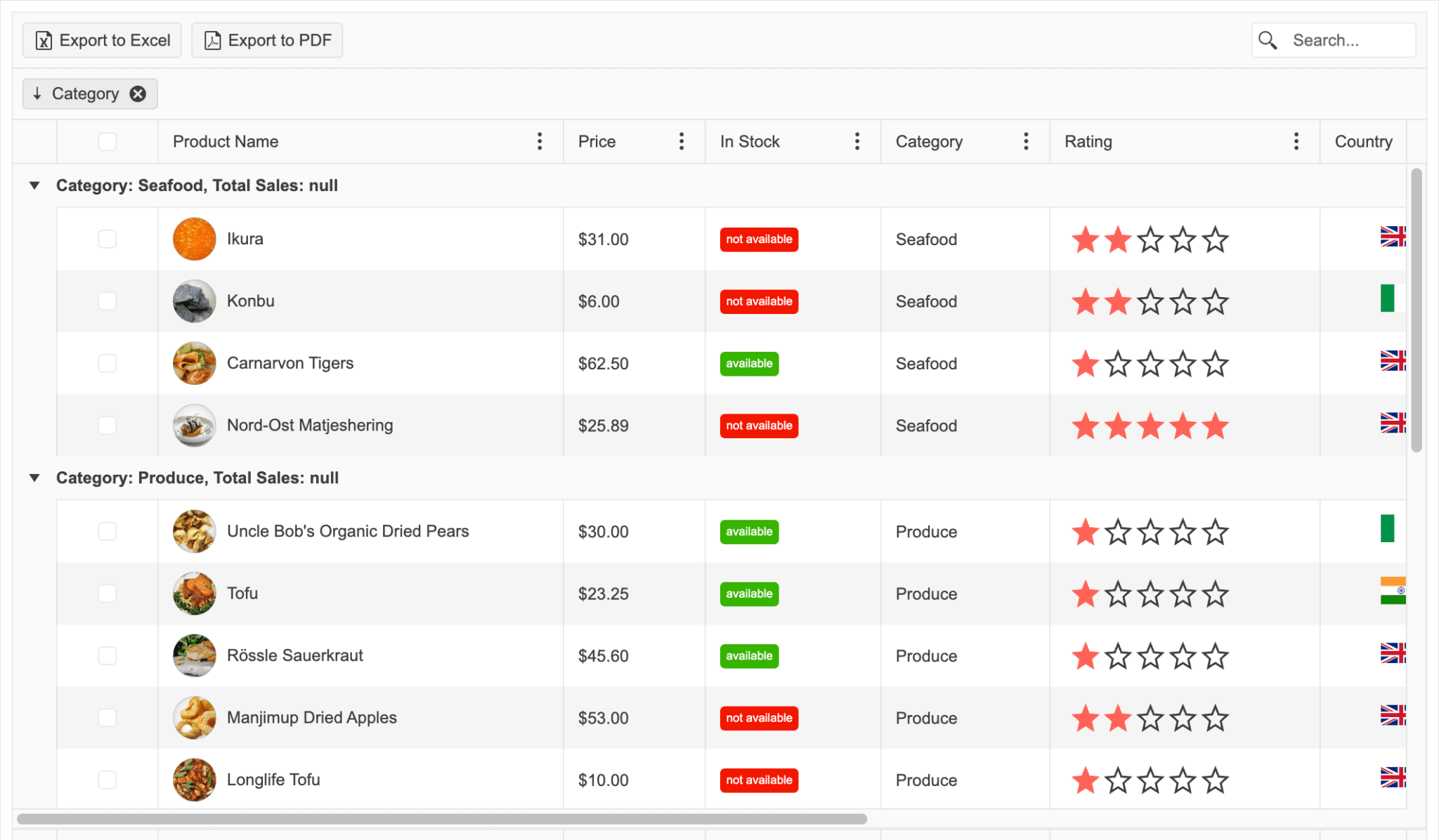
Kendo UI includes five themes for styling the grid. The following example shows a grid with the Default theme:
You can further customize the theme using the ThemeBuilder.
Features
Kendo UI JavaScript Data Grid’s features include:
- Inline, popup, and batch editing
- Grouping and aggregation
- Excel and PDF exports
- Nested grids
- Accessibility controls
- Chart integration
It also includes paging and virtualization features that improve its performance with large datasets.
Kendo UI also provides AI-enhanced components and features. For the Data Grid, these include:
- An AI Toolbar that lets users interact with grid data using natural language, such as voice prompts to sort and filter data. It also supports AI data operations and AI data highlighting for row-level insights.
- An AI column assistant for generating custom columns.
- An AI chat assistant integration.
The wider Kendo UI suite includes AI components you can pair with the grid, including AI Chat, SmartPaste, semantic search, an AI prompt and inline AI prompt, and editor AI integration.
Pricing
License pricing starts at $799 per developer per year and includes access to all Kendo UI components. Kendo UI offers volume discounts for multiple licenses and multi-year discounts for longer commitments.
There is a free 30-day trial available for the full version of Kendo UI.
Pros
The Kendo UI Grid offers several advantages:
- Access to the complete Kendo UI component suite, as well as to the ThemeBuilder, which includes a Figma-to-HTML converter
- An active blog and YouTube tutorials
- Documentation with code examples you can edit online in the Kendo UI Dojo
- A .NET data grid (like Syncfusion)
- Priority support with a 24-hour response time and an unlimited number of support tickets
- AI integration, including an AI Toolbar, AI column assistant, AI chat assistant, and suite-level AI components
Cons
Kendo UI doesn’t offer any free plans, and the pricing is expensive if you only need the JavaScript Data Grid. The Kendo UI site doesn’t include a demo to show how the grid handles large datasets.
Handsontable
Handsontable is a JavaScript data grid component, with spreadsheet functionality, for web applications. Its spreadsheet features include Excel- and Google Sheets-compliant keyboard shortcuts, formulas, and copy-paste functionality. It’s built with vanilla JavaScript and supports React, Angular, and Vue. The Handsontable demos page and documentation examples showcase demo grids.
Getting started
There are several ways you can add Handsontable to your project:
- Use npm.
- Use a CDN.
- Download the package and use the source files.
To create a basic Handsontable grid, you need to initialize the grid and pass in a configuration object:
import Handsontable from 'handsontable';

const container = document.querySelector('#example');
const hot = new Handsontable(container, {
  data: [
    ['', 'Tesla', 'Volvo', 'Toyota', 'Ford'],
    ['2019', 10, 11, 12, 13],
    ['2020', 10, 11, 12, 13]
  ],
  rowHeaders: true,
  colHeaders: true,
  licenseKey: 'non-commercial-and-evaluation'
});
You need a license key to use Handsontable. For projects covered by the free non-commercial license, use 'non-commercial-and-evaluation' as shown above.
To save data changes, you can track the changes made in your data grid using the afterChange hook:
afterChange(change, source) {
  if (source === 'loadData') {
    return; // don't save this change
  }

  if (!change) {
    return;
  }

  if (!autosave.checked) {
    return;
  }

  fetch('https://handsontable.com/docs/scripts/json/save.json', {
    method: 'POST',
    mode: 'no-cors',
    headers: {
      'Content-Type': 'application/json',
    },
    body: JSON.stringify({ data: change }),
  }).then(() => {
    exampleConsole.innerText = `Autosaved (${change.length} cell${change.length > 1 ? 's' : ''})`;
    console.log('The POST request is only used here for the demo purposes');
  });
},
Alternatively, you can save data to local storage.
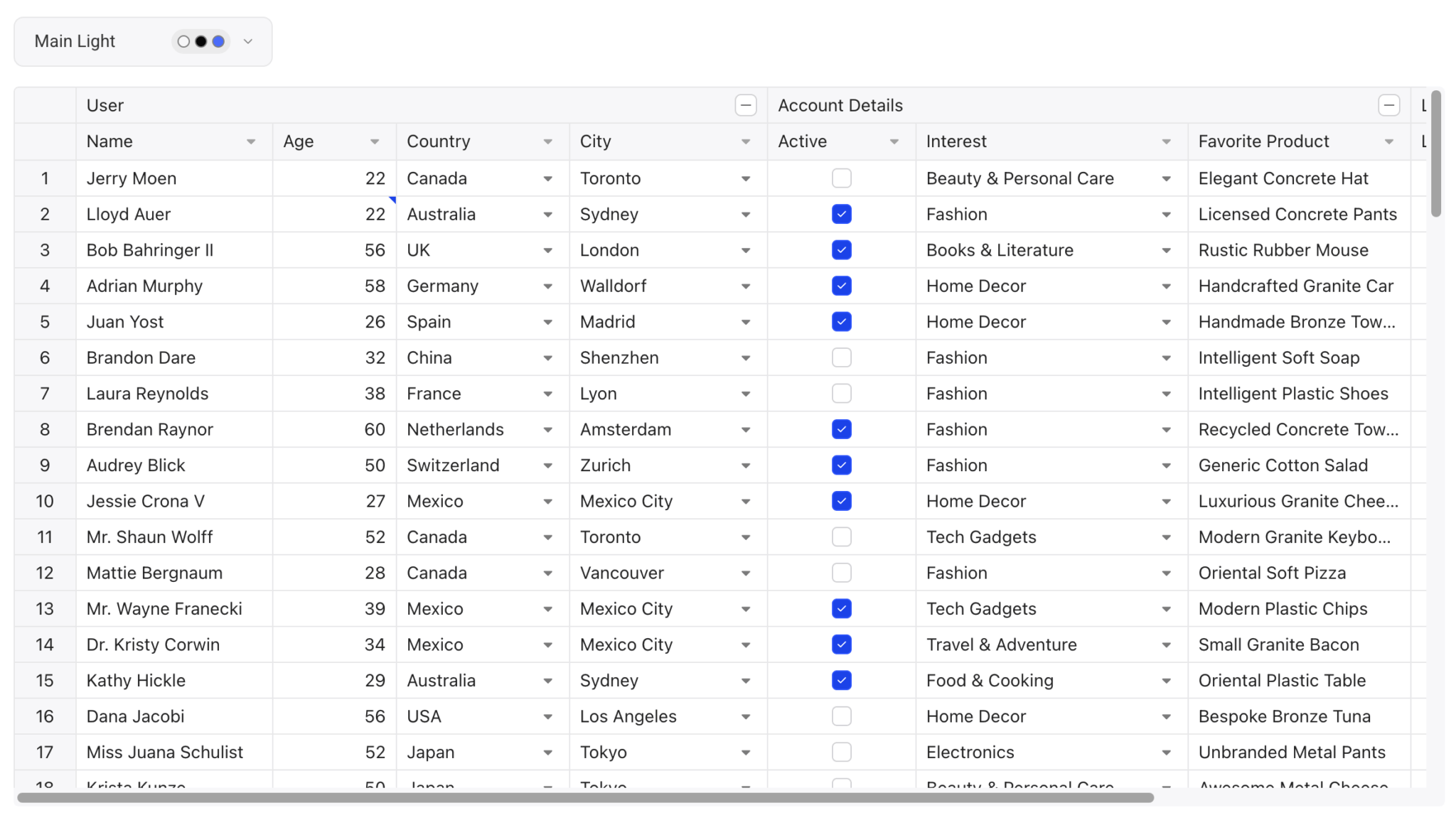
The Handsontable grid comes with six themes. You can apply a theme by importing the corresponding CSS file:
@import 'handsontable/styles/ht-theme-main.css';For example, the following grid showcases the default Handsontable theme:
You can use the Handsontable Theme Builder to further customize themes.
Features
Handsontable’s spreadsheet-like features include:
- Data validation
- Conditional formatting
- Hundreds of built-in formulas
- Merging cells
- Freezing rows and columns
- Context menus and keyboard shortcuts
- Accessibility features
- Cell comments
- Undo and redo functionality
Its performance-optimizing features include:
- Row virtualization for handling large datasets
- Batch operations
- Pagination support
View the virtualization demo to see how the grid handles displaying a large dataset.
Pricing
Handsontable offers two licensing options:
- Handsontable is available for non-commercial use and evaluation purposes, such as teaching, academic research, or evaluation. It allows access to all Handsontable features under the terms specified in the non-commercial license agreement.
- Commercial use of Handsontable requires a paid license, which includes support and maintenance. You need to contact sales to get a quote for a commercial license, starting at $999 per developer per year.
Pros
The spreadsheet functionality is Handsontable’s key differentiator. Other benefits include:
- Helpful documentation with good examples that you can edit online
- Access to a support forum
- A popular GitHub repo with over 21k stars, and support from the developer community in GitHub discussions and Stack Overflow
- An active blog featuring tutorials and a customer’s page featuring case studies
Cons
Handsontable doesn’t support lazy loading, which limits its performance with large datasets.
Like Syncfusion, Handsontable doesn’t provide transparent pricing, and you need to contact sales to get a quote for a commercial license.
Bryntum Grid
Bryntum Grid is part of Bryntum’s suite of commercial JavaScript components for project management and resource scheduling. It’s built with vanilla JavaScript and integrates with React, Angular, Vue, Salesforce, Ionic, or any backend. It can also be used as a web component. The Bryntum Grid demos page has examples showcasing its features and integrations.
Getting started
There are several ways you can add the Bryntum Grid library to your project:
- Try Bryntum Grid for free using the public trial package on npm:
npm install @bryntum/grid@npm:@bryntum/grid-trial- If you have a Bryntum license, refer to the npm repository guide and install the licensed package. You can then follow the integration guide for your framework.
npm install @bryntum/grid- Download the package if you want the source files and code examples.
To make a Bryntum Grid, create an instance of the Grid class and pass in a configuration object to the constructor (const) function. The configuration determines the appearance of the Bryntum Grid and where it gets data from:
import { Grid } from '@bryntum/grid';

const grid = new Grid({
    appendTo : 'app',
    columns  : [
        { field : 'name', text : 'Name', width : 200 },
        { field : 'city', text : 'City', flex : 1 }
    ],
    data : [
        { name : 'Dan Stevenson', city : 'Los Angeles' },
        { name : 'Talisha Babin', city : 'Paris' }
    ]
});
This code adds the grid to the page using the appendTo property, which is the DOM element (or the id of the DOM element) that the grid is added to as a child element.
The Bryntum Grid uses Store data containers for holding data. You can populate the grid with data in three different ways:
- Use inline or preloaded data, as shown in the code example above.
- Load remote data over HTTP using an AjaxStore.
- Respond to Store data requests (advanced usage).
The AjaxStore simplifies loading data from, and sending data updates to, a server. It uses the Fetch API to perform CRUD operations using URL strings:
const store = new AjaxStore({
    readUrl   : "/load",
    createUrl : "/create",
    updateUrl : "/update",
    deleteUrl : "/delete",
    autoLoad  : true,
});
Changes to the Bryntum Grid UI persist to the backend. When creating the API endpoints, the Bryntum Grid expects a specific response structure.
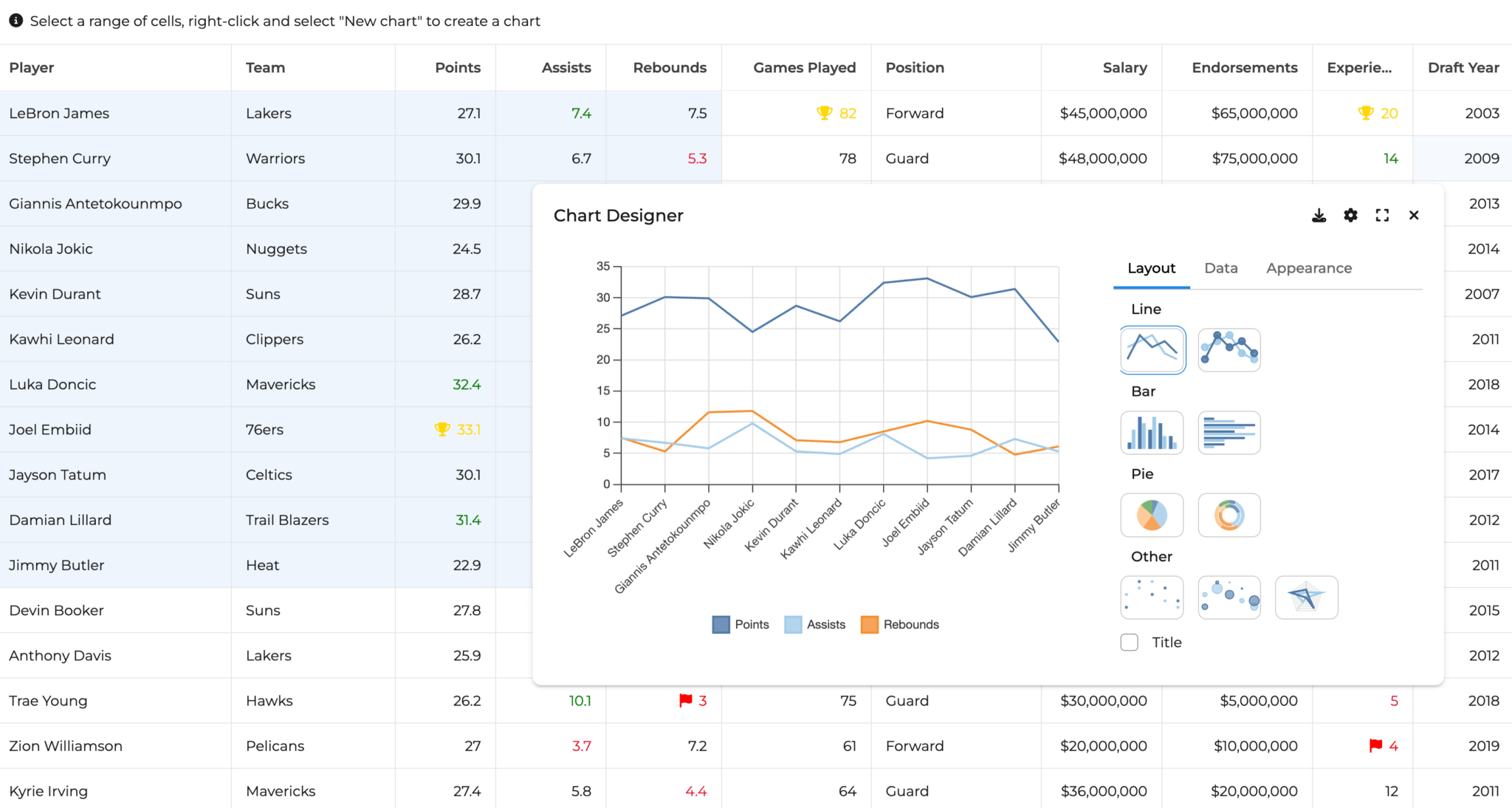
You can style the component using one of Bryntum’s available themes. For example, you can import the Svalbard theme in your CSS file as follows:
@import "@bryntum/grid/grid.svalbard-light.css";The following example demonstrates what the Svalbard theme looks like on a Bryntum Grid:
Features
Bryntum Grid’s features include:
- Locked columns
- Cell editing
- Custom cell rendering
- Row grouping and header grouping
- Filtering and search functions
- Tree grid formatting
- PDF and Excel export capabilities
It includes UI elements for customizing the grid, including buttons, menus, toggles, and sliders. Our kitchen sink demo showcases all of the widgets. It also features AI integration that lets you connect Bryntum Grid to your own LLM, so users can ask questions, filter data, sort records, create or update entries, and more through a chat panel, as shown in our AI-powered project summary demo. You can also use AI to generate content in grid cells. Examples include:
Bryntum also provides an MCP server that gives access to the latest version of the docs.
The Bryntum Grid big data demo showcases its performance-optimizing features, including:
- Virtual rendering
- Lazy loading
- Minimal DOM interactions
- Element reuse
- Modern CSS optimizations
- Accessibility features
Pricing
You can purchase Bryntum components individually or as a discounted bundle. The Bryntum Grid license starts at $600 per developer per year, and includes offers tailored for small teams, large teams, internal use, non-commercial use, and commercial use. The internal, non-commercial EUL license is perpetual and includes forum support and free upgrades for one year.
Bryntum offers a free trial via a public npm package, which you can install with npm install @bryntum/grid@npm:@bryntum/grid-trial. If you have a Bryntum license, refer to the npm repository guide to install the licensed packages with npm install @bryntum/grid. Bryntum also offers discounts for charity, environmental, and educational work, as well as for startups, and a discount if you publish a post about using Bryntum on your company blog.
Pros
Benefits of Bryntum Grid include:
- Extensive documentation that includes live code demos, good search functionality, and integration and migration guides
- An active blog where you can learn about customers’ experiences of using Bryntum components and follow tutorials such as Using a Bryntum TreeGrid with the GitHub GraphQL API
- A large selection of demos that include source code, tips for integration with various frameworks, and user-friendly search and filtering options
- Customer support via Bryntum’s support forum and professional services
- AI integration with a chat panel for natural-language grid control, AI-powered cell content generation, and an MCP server for up-to-date docs
Cons
Bryntum Grid is a commercial product without an open-source version, which makes it less suitable for basic use cases and projects with budget constraints.
Which JavaScript data grid should you choose?
Your choice depends on your budget constraints, feature requirements, and dataset size. Evaluate the comparison table to determine the best fit for your specific requirements:
| AG Grid | Syncfusion Grid | Kendo UI Grid | Handsontable | Bryntum Grid | |
|---|---|---|---|---|---|
| Open source version | ✔️ | ❌ | ❌ | ❌ | ❌ |
| Free for commercial use | ✔️ | ✔️* | ❌ | ❌ | ❌ |
| React, Angular, Vue support | ✔️ | ✔️ | ✔️ | ✔️ | ✔️ |
| TypeScript support | ✔️ | ✔️ | ✔️ | ✔️ | ✔️ |
| Lazy loading / Server-side | ✔️ | ✔️ | ✔️ | ❌ | ✔️ |
| Large dataset performance | ✔️ | ✔️ | ✔️ | ✔️ | ✔️ |
| Cell editing | ✔️ | ✔️ | ✔️ | ✔️ | ✔️ |
| Custom cell rendering | ✔️ | ✔️ | ✔️ | ✔️ | ✔️ |
| PDF/Excel export | ✔️** | ✔️ | ✔️ | ❌ | ✔️ |
| Theme builder GUI | ✔️ | ✔️ | ✔️ | ✔️ | ❌ |
| Built-in themes | ✔️ | ✔️ | ✔️ | ✔️ | ✔️ |
| Accessibility features | ✔️ | ✔️ | ✔️ | ✔️ | ✔️ |
| Tree grid / nested data | ✔️ | ✔️ | ✔️ | ✔️ | ✔️ |
| Advanced spreadsheet features | ✔️ | ❌ | ❌ | ✔️ | ❌ |
| AI integration | ✔️ | ❌ | ✔️ | ❌ | ✔️ |
| Charts integration | ✔️*** | ✔️ | ✔️ | ❌ | ✔️ |
| Transparent pricing | ✔️ | ❌ | ✔️ | ❌ | ✔️ |
| Interactive documentation | ✔️ | ✔️ | ✔️ | ✔️ | ✔️ |
* Syncfusion offers a free Community License for small companies
** AG Grid offers Excel exports with an Enterprise license
*** Community Integrated Charts are available within the AG Grid Enterprise licence. Purchasing an AG Charts licence provides access to Enterprise Integrated Charts.
Here are our recommendations based on the comparison:
| Use case | Requirements | Best choice |
|---|---|---|
| Budget / open source | Free for commercial use with core features | AG Grid Community |
| Enterprise / advanced | Handling large datasets and advanced features | AG Grid Enterprise, Bryntum Grid, or Kendo UI Grid |
| Spreadsheet functionality | Excel-like functionality: formulas and keyboard shortcuts | Handsontable |
| Small team / startup | Feature-rich with potential free license | Syncfusion Data Grid (if qualifying) |
| Complete UI suite | Need multiple components beyond just grids | Syncfusion Data Grid or Kendo UI Grid |
AG Grid suits most projects. The free Community edition covers core functionality without licensing costs and includes an MCP Server. The Enterprise version adds advanced features such as an AI Toolkit, master detail, context menus, and pivot tables. Its extensive documentation, large community, and transparent pricing make it a safe choice for both startups and enterprise teams.
Bryntum Grid is a solid commercial option. It includes AI integration, an MCP server, lazy loading, and nested grids. Starting at $600 per developer per year, it offers transparent pricing with extensive documentation, support, and live demos.
Handsontable is the pick when spreadsheet behavior is the core requirement rather than enterprise-grade data handling. It offers hundreds of built-in formulas, Excel- and Google Sheets-compliant keyboard shortcuts, cell validation, and a Theme Builder. It lacks native lazy loading for large datasets and requires contacting sales for commercial pricing, so it’s a weaker fit for enterprise datasets than the other grids in this comparison.
Syncfusion Data Grid is a strong enterprise-grade choice, with advanced features like Excel-like filtering, PDF/Excel exports with formatting preservation, chart integration, and AI-powered grid features like semantic filtering and anomaly detection. It’s also a good fit if you need a complete UI suite, and Syncfusion has a generous free Community License for small companies, which includes its Theme Studio GUI.
Kendo UI Grid is also a good choice for a complete UI suite. The AI Toolbar integration demonstrates Kendo UI’s AI capabilities.
Using data grids with Bryntum scheduling components
Bryntum specializes in scheduling and project management. Components like Scheduler Pro, Gantt, and Calendar pair well with data grids like AG Grid for applications that need both tabular data and resource planning.
For a practical example, see how to integrate a React AG Grid with Bryntum Scheduler Pro. For a more advanced use case combining tabular data with location-based scheduling, visit building a location-based scheduler with Bryntum Scheduler Pro, TanStack Table, shadcn/ui, and Mapbox.
React support
All of the grids we’ve compared support React, Angular, and Vue. For Svelte developers, see our detailed Svelte tables comparison.
For React applications, AG Grid Community provides the best free integration with its ag-grid-react package. For commercial enterprise features, Bryntum Grid, Kendo UI Grid, and AG Grid Enterprise all offer React support.
Our data grid recommendation
AG Grid is our top pick, offering a free Community edition, thorough documentation, strong large dataset performance, a large and active community, and a clear upgrade path to Enterprise features.